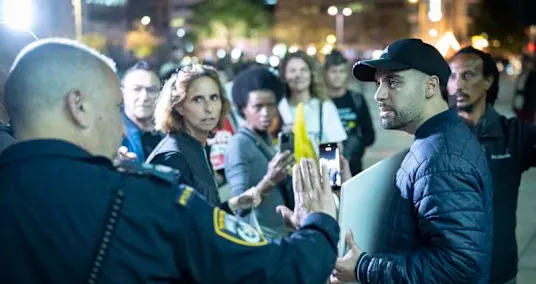
Protests took place in Tel Aviv, Jerusalem, Haifa, and Beersheba, as a survey found broad but uneven support among Jewish Israelis for Operation Roaring Lion.
Israel Police arrested 21 anti-war protesters Saturday night as demonstrations against the conflict with Iran expanded in multiple cities despite restrictions on public gatherings.
Protests took place in Tel Aviv, Jerusalem, Haifa, and Beersheba, with hundreds of participants reported in Tel Aviv and Jerusalem and about 100 in Haifa, marking the largest turnout since weekly demonstrations began. Authorities said 13 people were arrested in Tel Aviv and eight in Haifa.
Police said the gatherings were not approved under Home Front Command regulations that ban events with more than 50 people. Officials said the increase in turnout followed calls by groups opposing the government to protest despite the restrictions.
“During a situation assessment that took place at the scene with a Home Front Command representative… it was clarified that there was a real risk to human life and accordingly, Yarkon [precinct] police commander Tzachi Sharabi ordered the gathering to be dispersed,” police said.
Hadash-Ta’al chairman Ayman Odeh, an Arab lawmaker involved in the protests, criticized the police response, calling officers fascists “in the service of the government” and saying they were afraid of “the heroic citizens who went out, despite everything, to make their voice heard.”

Survey shows broad, uneven support for war
The demonstrations come as a March 2026 survey by the Israel Democracy Institute found broad but uneven support among Jewish Israelis for Operation Roaring Lion. Support was strongest on the Right at 87% and about half on the Left.
The survey also found that Jewish and Arab respondents largely agreed that Iran’s resilience has been stronger than expected. Most Jewish respondents said Israeli society could sustain the campaign for up to one month, while 28% said as long as needed. Arab respondents were less optimistic about how long the public could endure the conflict.
A majority of Jewish respondents said Prime Minister Benjamin Netanyahu’s decision was driven by security considerations, while most Arab respondents viewed it as political.
LATEST POSTS
- 1
 The most effective method to Pick the Ideal Lab Precious stone Wedding band
 - 2New law puts familiar drinks, creams and gummies in legal limbo
- 3Netflix is releasing a documentary on Elizabeth Smart. What to know about her kidnapping, rescue and where she is now.
- 4Israel strikes Iranian nuclear development facilities, Tehran vows retaliation
- 5Find the Specialty of Calligraphy: Dominating the Exquisite Art of Penmanship





- The new queen of country music has no scandals and no gimmicks — and just broke a record set by Taylor Swift
- Mysterious bright blue cosmic blasts triggered by black holes shredding stars, scientists say. 'It's definitely not just an exploding star.'
- Mating injuries may lead scientists to identify dinosaurs’ sex
- Investigate These Retreats Well known With Seniors
- Paratroopers kill terrorist who threw rocks at Israeli citizens, soldiers near Ofra in West Bank
- Figure out How to Consolidate Cutting edge innovations in Senior's SUVs
- NASA chief Jared Isaacman says Texas may get a moonship, not space shuttle Discovery
- Distributed storage Answers for Information Reinforcement
- 'The Golden Bachelor' Season 2 finale: How to watch tonight, start time, where to stream and more